


On April 2nd 2025 President Donald Trump unveiled his “Liberation Day” tariffs, the cornerstone of his economic policy agenda. Five months later, despite most of the originally proposed rates being delayed or cancelled, US tariff rates are the highest they’ve been in a century. These aggressive moves are being justified in many ways—often contradictory—but the central argument is that tariffs will provide an economic boost to domestic manufacturing. Unfortunately the President’s actual policy is almost specifically designed to do the exact opposite.
What’s a Tariff?
Put simply a tariff is an import tax, when a foreign good arrives at US Customs the federal government adds a surcharge based on the cargo’s price the same way a state sales tax adds a surcharge to every retail purchase. The specific details of which tariff rates apply to which goods from which countries are constantly changing and any written summary would likely become outdated by the time I finished writing the sentence. According to many federal courts these tariffs may not even be legal in the first place and could very well be nullified. Instead I will discuss the economic thought behind these tariffs and why they fail both in theory and in practice.
The argument for how tariffs can support domestic manufacturing isn’t much more complicated than an Econ 101 supply-and-demand graph. For a variety of reasons, foreign producers can manufacture goods at a lower cost than American factories. American firms can’t afford to sell goods at this lower price and lose customers because consumers prefer buying cheaper goods. By raising the price of foreign goods tariffs can help domestic manufacturers compete with foreign firms by eroding some of that price advantage. Of course this comes at the expense of domestic consumers who pay higher prices but as Treasury Secretary Scott Bessent put it, “access to cheap goods is not the essence of the American dream” (CNBC).
Most discussion over the President’s tariff policies center on this tension, debating whether it is a worthwhile trade-off to pay higher prices for the sake of supporting specific industries. While I’m definitely on board with many of these arguments against tariffs, in practice it’s a bit of a moot point because these tariffs aren’t even accomplishing their supposed goal. Understanding why requires us to graduate to Econ 102.
An obvious omission from the simple model described above is the fact that American producers are also American consumers. Those of you that have taken an economics class before will recognize the term marginal cost: what it costs to produce each individual product. This marginal cost comes in two parts, the labor cost of paying employees and the input cost of materials used to make the product. American factories who buy their input materials from overseas are subject to the same tariffs as the rest of us. The counterpart of marginal costs are fixed costs; these are one-time costs that aren’t directly related to how many products are made. Examples include research and design or capital investment—the latter of which is also subject to the higher prices of tariffs (e.g. steel used to build a new factory).
Whether or not these increased costs outweigh the potential benefits of tariffs for manufacturers is an empirical question. Judging by the past five months, the evidence we have so far seems to be pointing in one direction. According to the latest BLS report manufacturing jobs are down 78,000 over the year (BLS). If you don’t trust numbers from the Bureau of Labor Statistics (much like our President) then taking a look at private analysts and manufacturing firms themselves will paint a similar picture. Tej Parikh with the Financial Times recently reported that many parts of the United States may already be experiencing recession-like conditions, in particular construction and manufacturing industries. Nazmul Ahasan with Bloomberg reports that as of October 1st manufacturing activity in the United States has been contracting for seven straight months according to the Institute for Supply Management.
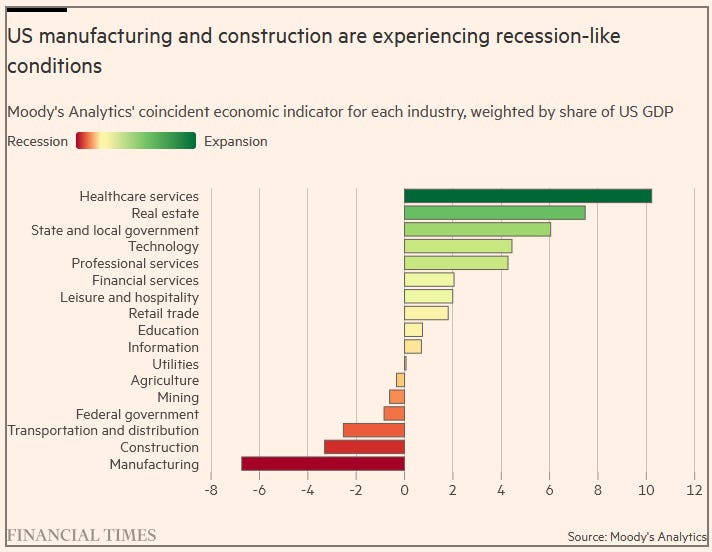
As of October 1st manufacturing activity has contracted for seven straight months ac
On a particular level, the effects can be seen in many individual firms as well. In their Q2 2025 investor report Ford specifically mentions “$0.8 billion of adverse net tariff-related impacts” this quarter and projected for a yearly “net tariff-related headwind of about $2 billion.” This is entirely predictable for anybody who knows how interconnected global supply chains are in the modern world. Every American manufacturer relies upon the free flow of international trade. Often times single products will cross national borders several times before their final sale. The final product being assembled on American soil doesn’t save the company any money if they have to pay for every widget, nut, or bolt that arrives from overseas. Take John Deere for instance, an American farming equipment manufacturer that the President has personally squabbled with in the past. Just this one American firm owns and operates factories in France, China, Argentina, India, Mexico, and supplies some of its tractor engines from Japan and Germany (SlashGear).
It could be possible to excuse the consequences of the President’s current policies as a failed experiment if it weren’t for the fact that he previously attempted such an experiment to similar results.
Fool Me Once, Fool Me Twice
During his first Presidential term Donald Trump implemented high tariffs on foreign steel and aluminum in an attempt to support American manufacturing. The results speak for themselves. In a report published by the Federal Reserve, economists Aaron Flaaen and Justin Pierce found that the net effects of these steel and aluminum tariffs was a significant decrease in manufacturing employment, an indeterminate effect on industrial production, and an increase on producer prices.
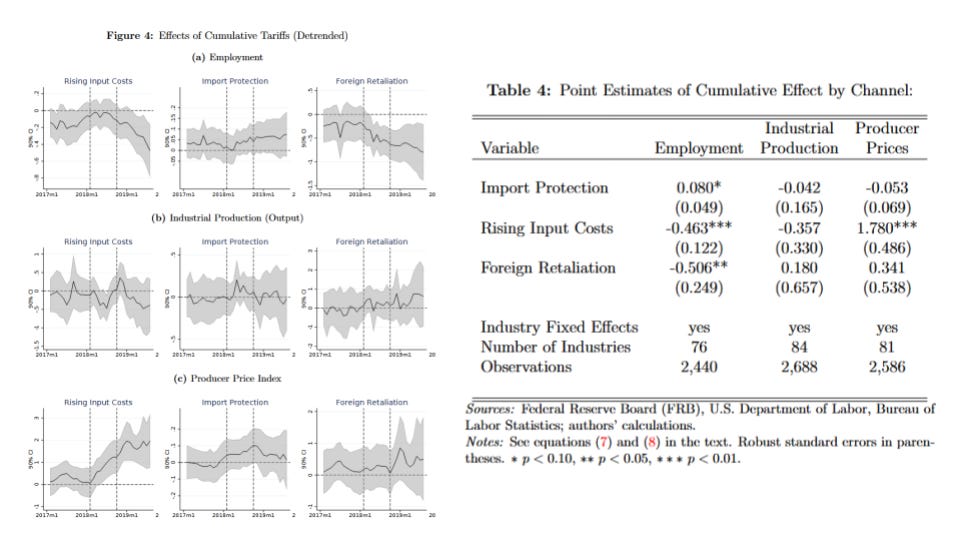
The mechanisms behind these outcomes are the ones predicted by practically every economist on the planet. Raising the price of foreign steel and aluminum may help some domestic steel and aluminum manufacturers compete, but every manufacturer that uses steel or aluminum in their production suffers the higher cost. Additionally, other countries tend to implement their own retaliatory tariffs which are often targeted towards specific industries to cause the most stress. In this case, China responded to President Trump’s tariffs with their own tariffs on American soybeans. Soybean exports to China fell by an estimated 75% and the Trump administration spent $28 billion to bail out struggling farmers (NFAP).
To say the President is doubling down on this failed strategy would be, quite literally, the understatement of the century; the last time the United States had tariffs this high was in 1934 during the Great Depression. Many economists and historians agree that those dramatic tariffs then were a significant contributor to the era’s prolonged economic malaise. This time if we do fall into recession or worse tariffs are the clear and obvious cause.
Many on Wall Street breathed a collective, if tentative, sigh of relief over the course of the summer as President Trump walked back his most aggressive tariff rates and implemented several delays, pauses, and exemptions to lessen the impact from his Liberation Day announcement. While the stock market has since recovered from the damage caused back in April, it’s important to remember that the S&P 500 is not a comprehensive indicator for the health of the economy. A majority of stock market gains in the past year can be attributed to the Magnificent 7; a collection of tech companies seeing huge valuations due to AI speculation. Joseph Politano has pointed out that one of the key exemptions to Trump’s tariffs is computer equipment, which could potentially paint a misleadingly optimistic picture of how healthy the broader economy is right now. Plus we’re not out of the woods just yet on tariffs, as just last week the President suddenly announced that he planned to (again) implement 100% tariffs on China.
It’s Not Just Tariffs
The extent of President Trump’s self-sabotage is not limited to just trade policy and tariff rates. It’s almost impressive how comprehensive and holistic his efforts to cripple American manufacturing appear to be. While tariffs are crippling domestic manufacturers by raising their input costs and making capital investments costlier, the President’s harsh immigration policy and ideological opposition to renewable energy is killing the labor force and cancelling worthwhile projects.
In early September ICE raided a Hyundai manufacturing plant in Savannah, Georgia and detained 475 workers. The facility employs 1,200 people in total and has been touted by Georgia Governor Brian Kemp as the state’s largest economic development project. Over 300 of those detained were South Korean nationals and after being released from captivity all but one boarded a flight back to South Korea. Specifically, the raid targeted an under construction expansion to the facility that would produce batteries for the electric vehicles being made next door. According to Hyundai CEO Jose Munoz the raid could delay the battery plant’s opening by a minimum of two to three months.
Republicans in Congress have failed to secure the necessary votes to pass a federal budget and as a result the government has been shutdown since October 1st. On that same day, Office of Management and Budget Director Russ Vought announced that more than $7 billion of federal spending on energy projects that he described as “Green New Scam funding” was being cancelled. This funding was allocated to over 220 projects across 16 states, all of which voted for Kamala Harris in the 2024 election. It remains unclear whether these cancellations are legal or whether they will actually go into effect, but hostility to renewable energy projects is a broad trend in the current administration’s policy.
Soon after President Trump took office he signed an executive order attempting to pause grant payments related to the Inflation Reduction Act and Infrastructure Investment and Jobs Act, two legislation packages which devoted billions of dollars to renewable energy and infrastructure projects. He also ordered federal agencies to stop issuing permits for offshore wind projects. Just last week the administration cancelled a 6.2 gigawatt solar project in Nevada. All of this is coinciding with increasing energy demands as power-hungry data center construction continues to grow. Simple economics tells us that decreases in supply and increases in demand puts upward pressure on prices, and that pressure is already being felt by American consumers. A report by the Center for American Progress finds that people in 41 states are facing increased electricity bills, in part due to the administration’s hostility to renewable energy investment. Business leaders share the same concerns about where the administration’s priorities lie.
“At a time when we’re all very concerned about energy abundance and this administration’s broad goal of re-establishing energy dominance, just the idea that we’d be constraining the build of new energy [infrastructure] really feels like it’s rowing in the wrong direction”
-Rich Powell, chief executive of the Clean Energy Buyers Association
Fully Automatic Podiatric Ballistics
All of these policies point in the same, self-sabotaging direction. Despite the administration’s rhetoric of re-invigorating the American economy and ushering in a golden age of domestic manufacturing, their actual policies are almost perfectly designed to kneecap American industry. Shuttering what would be one of the largest solar plants in the world doesn’t contribute to energy dominance. Taxing Ford for importing foreign steel and aluminum doesn’t support the American car industry. Foreign investors are going to be more hesitant about building factories in the United States if they’re likely to get raided by armed federal agents and have their employees abducted. Unless this administration dramatically changes course it seems inevitable that their promised Golden Age will look a lot more like the Dark Ages.
This is a pretty retarded take ngl